
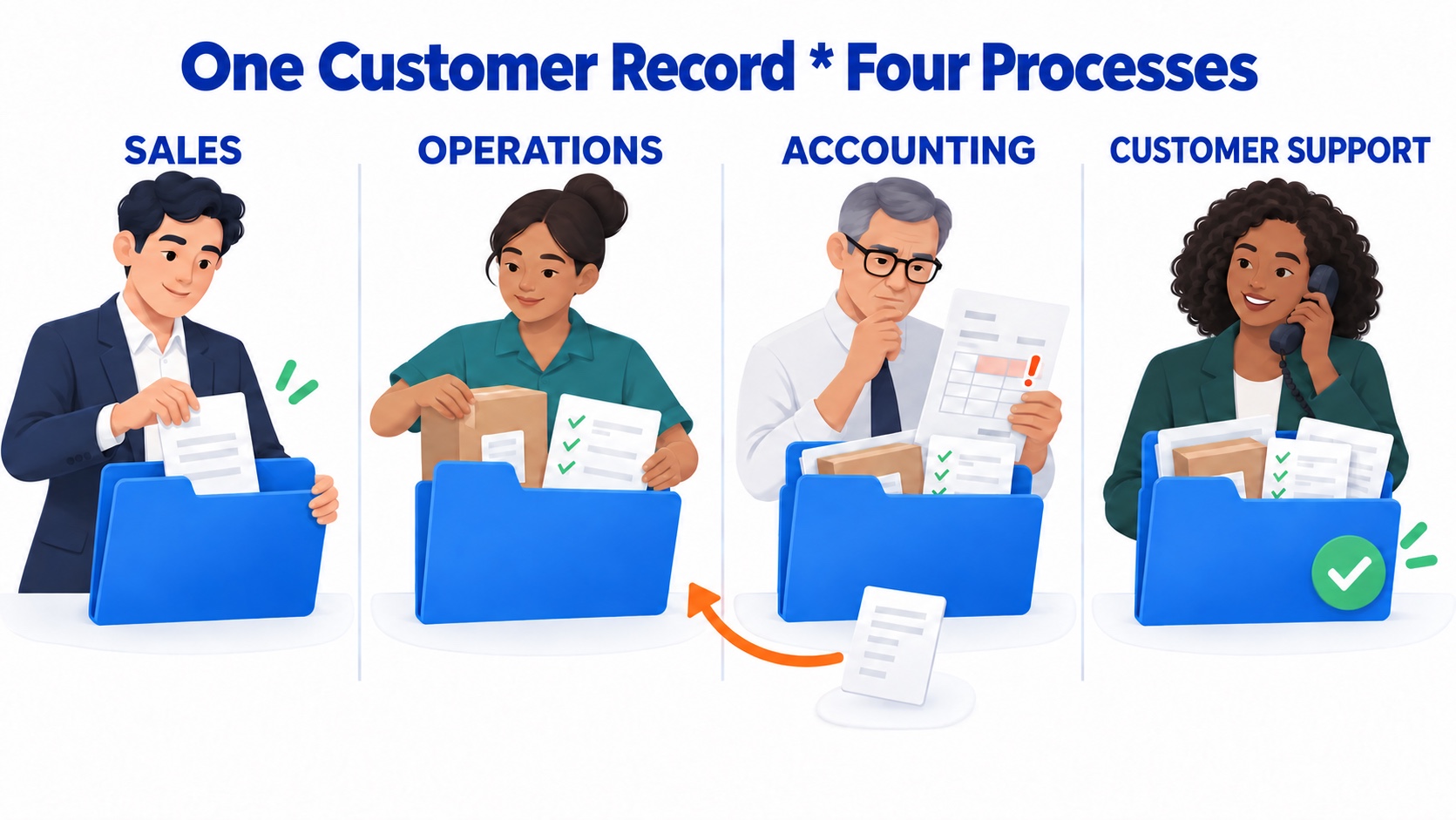
A customer experiences one relationship. Inside the organization, four processes use the customer record for different work: Sales records the agreement, Operations delivers what was promised, Accounting records the financial result, and Customer Support helps the customer when a question or problem occurs.
Those processes do not need to use the same screen or even the same application. They do need the shared facts to keep the same meaning as the work moves from one team to the next.
One record does not mean one team owns everything
Each process has a different responsibility:
- Sales records what the customer agreed to buy, including the approved offering, price, quantity, timing, and terms.
- Operations uses that agreement to deliver the product, service, access, or work the customer expects.
- Accounting uses the approved agreement and evidence of delivery to create and record the invoice, payment, and revenue recognition as the correct financial result.
- Customer Support needs enough of the same record to explain what the customer should receive, recognize when the experience differs, and route a correction to the right owner.
The customer record connects these responsibilities. It should not erase them.
Define the facts all four processes share
Before technology carries the record from one process to another, the organization must agree on the facts that cannot change meaning along the way. At minimum, the four processes may need to share:
- The customer identity
- The product or service purchased
- The approved price, quantity, and service level
- The effective, delivery, renewal, or end dates that apply
- The current status of the agreement
- Any approved change and the date it takes effect
One process may create a fact and another may use it, but they should not quietly redefine it. If Operations receives a different service level than Sales approved, or Customer Support sees a different effective date than Accounting used, the organization no longer has one dependable customer record.
Make each handoff visible
The record moves through a sequence of handoffs. Sales must provide Operations with enough information to deliver the agreement. Operations must record what was delivered so Accounting can recognize the correct result. Customer Support must be able to compare the customer’s experience with the agreement and the delivery record.
A handoff is complete only when the receiving process has the information needed to act. Sending a record is not enough if a required date is missing, a service level is unclear, or the customer cannot be matched to the agreement.
A change must reach the processes it affects
Customer records do not remain still. A customer may change a quantity, renew, cancel, report a delivery problem, dispute a charge, or request a correction. The organization must decide who can approve the change, when it becomes effective, and which of the four processes must respond.
A change is not complete because one person updated one field. Sales may need to confirm the revised agreement. Operations may need to alter delivery. Accounting may need to correct the financial record. Customer Support may need to explain the result to the customer. Only the affected processes should be involved, but none should be left working from an outdated version.
Test the customer result, not four isolated tasks
Testing each process separately can show that its steps work. It cannot prove that the organization produces the right customer result.
Follow one customer record through the complete path. Can Sales’ approved agreement be traced to what Operations delivered? Does Accounting reflect that same agreement and delivery? Can Customer Support see enough to explain the result and recognize an exception? Then test a change or correction and confirm that each affected process receives the updated facts.
The goal is not four teams duplicating the same work or one application controlling every decision. The goal is one dependable customer record supporting four clearly defined processes. Once the facts, ownership, and handoffs are clear, technology can reinforce the connection instead of creating four different versions of the customer.